

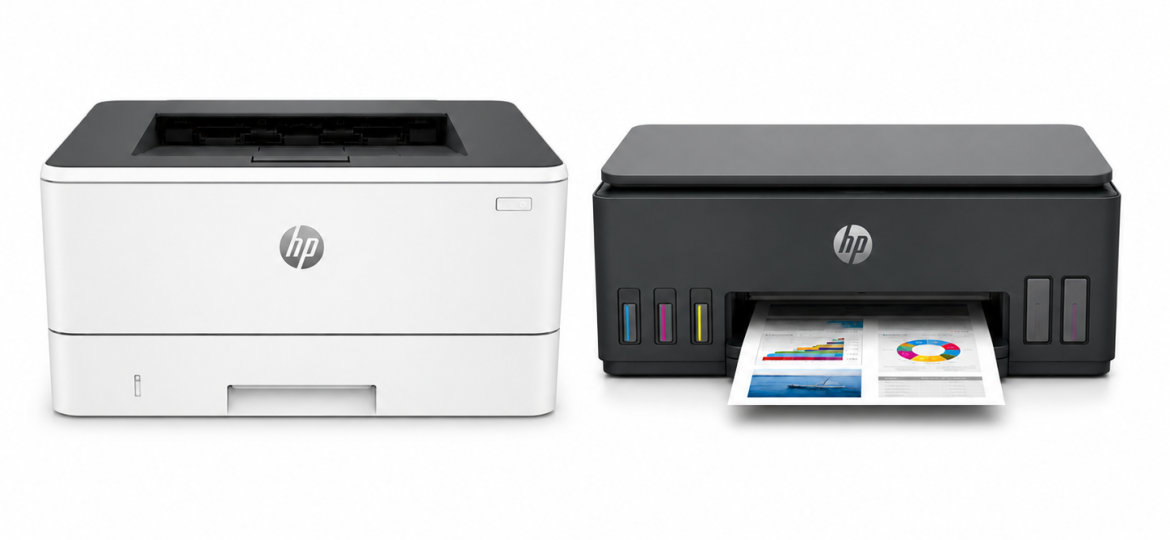
At a reseller counter in Onitsha, a customer holding a printed quote for two machines asks the question every TD Africa partner hears at least once a week: “Which one is actually cheaper?” It sounds like a simple question. It isn’t. The honest answer depends on how many pages the business prints, what colour those pages are, how long the printer needs to survive, and, often overlooked, whether the ink or toner behind it is genuine.
That question, laser or tank, is the single most common decision point at reseller counters across different regions of Africa, and the honest answer, backed by independent lab testing rather than marketing copy, is that neither technology wins outright. The right recommendation from an authorised distributor depends entirely on how a specific business prints, and resellers who understand the underlying economics will close the sale with confidence instead of guesswork.
The Real Question Isn’t Which Printer Is Cheaper
Independent print-lab testing has consistently found that ink tank printers hold a clear cost-per-page advantage, particularly for colour output, while laser holds its ground on text-heavy, high-durability work. But testing data also makes an important correction to the popular narrative: cost per page alone doesn’t determine which printer actually saves a business money. What matters is total cost of ownership (TCO), the purchase price of the device plus the cost of every page printed over its working life.
If one printer costs one naira-equivalent less per page than another, but its upfront price is ten thousand naira higher, a business has to print ten thousand pages before that cheaper running cost pays back the higher purchase price. Print fewer pages than that, and the “cheaper to run” printer actually costs more overall.
Print more, and it starts saving real money. This is the calculation resellers should be walking every business customer through, not just quoting a lower cost-per-page number and hoping it closes the deal.
The Real gap: Cost per page, and where it actually shows up
When lab testing breaks down actual running costs across a large sample of devices, the pattern is consistent and worth knowing in detail and at today’s exchange rate, the naira gap is even starker than the raw cent figures suggest:
- For monochrome text pages, laser printers typically cost roughly ₦15 to ₦59 per page, while ink tank printers mostly run under ₦14, occasionally reaching up to about ₦28. Ink tank holds an edge here, but it’s a modest one, the kind of gap a business printing a few hundred pages a month won’t feel either way strongly.
- For colour pages, the gap widens dramatically. Laser colour output typically costs roughly ₦178 to ₦266 per page, while ink tank output, because it draws from bottled ink rather than small cartridges, typically costs under ₦28 per page. On a single coloured proposal or a batch of branded flyers, that difference adds up fast, especially with import costs already built into every consumable that crosses the border.
That gap is the entire reason ink tank technology has reshaped the printer market over the past several years. It didn’t happen because tank printers got cheaper to buy; it happened because bottled ink broke the traditional cartridge economics that made colour printing expensive everywhere, including in markets where every consumable already carries an import premium.
For a business printing mostly black-and-white invoices and contracts, that colour-page gap barely matters. For a business producing client proposals, branded flyers, or coloured reports, it’s the difference between a printer that’s affordable to run and one that quietly drains the office budget every month.
What laser still does better and why it matters for durability-first customers
Independent testing draws out three areas where laser consistently outperforms ink tank technology, and they’re worth stating plainly to any customer weighing the decision:
- Text and fine detail: Toner fuses to the surface of the page rather than absorbing into it, which keeps small font sizes and fine line graphics sharper. Ink, by contrast, can spread slightly at the edges and lose contrast on absorbent paper, a difference that shows up most at very small text sizes.
- Water and fade resistance: Because toner is a solid fused to the page rather than a liquid absorbed into it, laser-printed documents resist smearing from spilt water and hold their colour longer over time. For contracts, certificates, or any document a business needs to survive years in a filing cabinet or a market stall, that durability matters more than cost per page.
- Reliability after periods of disuse: Laser printers have no nozzles to clog. A unit left idle for weeks or months will print immediately when switched back on. Ink tank printers, like all inkjet technology, can develop clogged nozzles during long idle periods, and many models run automatic self-cleaning cycles that quietly consume ink even when nothing is being printed, a detail worth flagging to seasonal or low-volume customers who might otherwise be surprised by ink use with nothing to show for it.
Where ink tank pulls ahead beyond running cost
The advantage isn’t only about cost per page. Ink tank technology’s edge in colour vibrancy and photo quality, particularly on speciality or glossy paper, where ink tank output consistently outperforms laser regardless of the laser unit’s price point. For businesses producing marketing collateral, branded proposals, or anything client-facing where colour accuracy matters, this is a genuine quality argument, not just a cost one.
Framing the decision for a customer at the counter
The most useful thing a reseller can do is translate this into a short, honest conversation rather than a spec-sheet recitation:
- High-volume, text-heavy, document-driven businesses: Billing counters, legal offices, logistics firms processing waybills should lean laser. The text sharpness, durability against handling and moisture, and reliability after idle periods all favour daily, high-pressure use.
- Colour-heavy, lower-volume, client-facing businesses: Design studios, small consultancies, marketing-led SMEs should lean Smart Tank. The colour cost-per-page advantage and photo-quality edge outweigh laser’s durability benefits for businesses that aren’t printing thousands of pages a month.
- Mixed or growing businesses: The total cost of ownership conversation explicitly, how many pages a month, what proportion is colour, and how long they expect to keep the device. That conversation, not a fixed brand preference, is what prevents a customer from buying a machine that’s wrong for their volume and returning six months later disappointed.
The consumable question that decides whether any of this math holds
Every cost-per-page figure above assumes genuine HP toner and genuine HP ink, sourced through an authorised channel like TD Africa. That assumption breaks down the moment a business substitutes refilled or unauthorised cartridges to save money upfront, a common temptation given how consumable pricing is affected by import costs and currency movement across the region.
Unauthorised toner can damage the imaging drum in a laser printer, turning a short-term saving into a full unit replacement. Unauthorised ink formulations are a leading cause of clogged printheads in tank systems, the same failure mode that idle time causes naturally, made worse. In both cases, unauthorised consumables void the manufacturer’s warranty, leaving the business with no recourse when the damage shows up.
This is where authorised distribution stops being a compliance detail and becomes the thing that makes the entire cost calculation trustworthy. A device and its consumables sourced through an authorised partner carry a warranty that holds, genuine yields that match the numbers a reseller quotes, and a support path that’s still there when something goes wrong.
HP LaserJet vs. Smart Tank
| Factor | HP LaserJet | HP Smart Tank |
| Best volume fit | High-volume, text-heavy printing | Lower-volume, colour-heavy printing |
| Text & fine detail | Sharper, toner fuses to the page surface | Can spread slightly at edges, especially at small font sizes |
| Water & fade resistance | Strong toner won’t smear from spills | Weaker ink can smear and fade faster over time |
| Reliability after idle periods | Prints immediately, no nozzles to clog | Risk of clogged printheads; some models run ink-consuming self-cleaning cycles |
| Colour vibrancy & photo quality | Weaker on specialty/glossy paper | Consistently outperforms laser, regardless of laser’s price point |
| Best-fit business type | Billing counters, legal offices, logistics firms processing waybills | Design studios, small consultancies, marketing-led SMEs |
| What it wins on | Durability, text sharpness, reliability through idle periods | Colour running cost, photo quality |
| Underlying requirement for these numbers to hold | Genuine HP toner, authorised channel | Genuine HP ink, authorised channel |
Conclusion
Laser and Smart Tank aren’t competing for the same customer; they’re solving different printing problems. Laser wins on durability, text sharpness, and reliability through idle periods. Smart Tank wins on colour running cost and photo quality. The total cost of ownership, not the sticker price or a single cost-per-page number, is what actually determines which one saves a business money, and that calculation only holds if the ink or toner behind it is genuine.
Resellers who lead with this framework, rather than a fixed brand loyalty, sell the right device on the first visit, and keep that customer coming back for consumables instead of complaints.
FAQs
- If ink tank printers cost less per page, why would a business ever choose laser instead?
Cost per page is only one part of the total cost of ownership. Laser printers hold clear advantages in text sharpness, durability against water and handling, and reliability after sitting idle for weeks. - How many pages a month does a business need to print before a Smart Tank actually pays for itself?
There’s no fixed number; it depends on the price gap between the two specific machines and how much of the printing is colour. - Does it matter where a business buys its ink or toner refills, as long as the printer works?
Yes, and it’s the detail most likely to undo the savings on paper. Unauthorised toner can damage a laser printer’s imaging drum, and unauthorised ink formulations are a common cause of clogged printheads in tank systems, both failures that void the manufacturer’s warranty and turn a short-term saving into a full repair or replacement cost.
