

There’s a particular kind of pressure that lands on an IT manager’s desk right before a server order goes out. The business has outgrown what it’s running on — maybe it’s a bank rolling out a new core application, a hospital digitising patient records, or a fast-growing SME that finally needs a dedicated server instead of a repurposed desktop under someone’s table. Whatever the trigger, the order can’t wait, and the cost of getting it wrong isn’t just financial. It’s downtime, it’s a warranty claim that goes nowhere, it’s an auditor asking where the hardware came from and nobody having a clean answer.
That’s the real starting point for this guide. Not “which HPE server is the best,” because HPE’s enterprise credibility in Nigeria isn’t in question. The real question is how to order the right server, through the right channel, in a way that protects the business long after the invoice is paid.
Why the sourcing decision matters as much as the spec sheet
Despite having entirely distinct processors, RAM configurations, storage options, expansion capabilities, and workloads, two servers can both be referred to as HPE ProLiant servers. For virtualisation, databases, artificial intelligence, or high-performance computers, a configuration that is ideal for a small organisation could be totally inappropriate.
Platforms built on more recent Intel Xeon 6, AMD EPYC CPUs, DDR5 memory, and PCIe Gen5 connectivity, and enhanced management and security technologies are all part of HPE’s ProLiant Compute Gen12 offering in 2026. High-performance GPUs and sophisticated cooling setups are also supported by HPE, depending on the model.
Because of this, it becomes more crucial to comprehend the specification sheet before making a purchase.
This guide explains how to check HPE Server specifications and which specifications deserve the most attention.
HPE’s current ProLiant Compute lineup is built around a straightforward promise: a secure foundation for hybrid workloads, with built-in protections like the HPE iLO Silicon Root of Trust and AI-driven automation designed to simplify operations from the data centre to the edge. On paper, that’s exactly what a Nigerian enterprise buyer needs, reliable compute that can be managed centrally, secured by default, and scaled as workloads grow.
But that value only holds if the server that arrives is the server HPE actually built. Nigeria’s server market includes a wide range of sourcing options, from fully authorised distribution to unauthorised market units imported without manufacturer backing. A server bought outside an authorised channel can look identical in a listing, and still arrive without a valid Nigerian warranty, with firmware that can’t be verified, or with parts substituted somewhere along a supply chain nobody can fully trace. For a data centre workload running production applications, that’s not a small risk — it’s the difference between a support ticket that gets resolved in hours and one that never gets resolved at all.
Step 1: Define the workload before you define the server
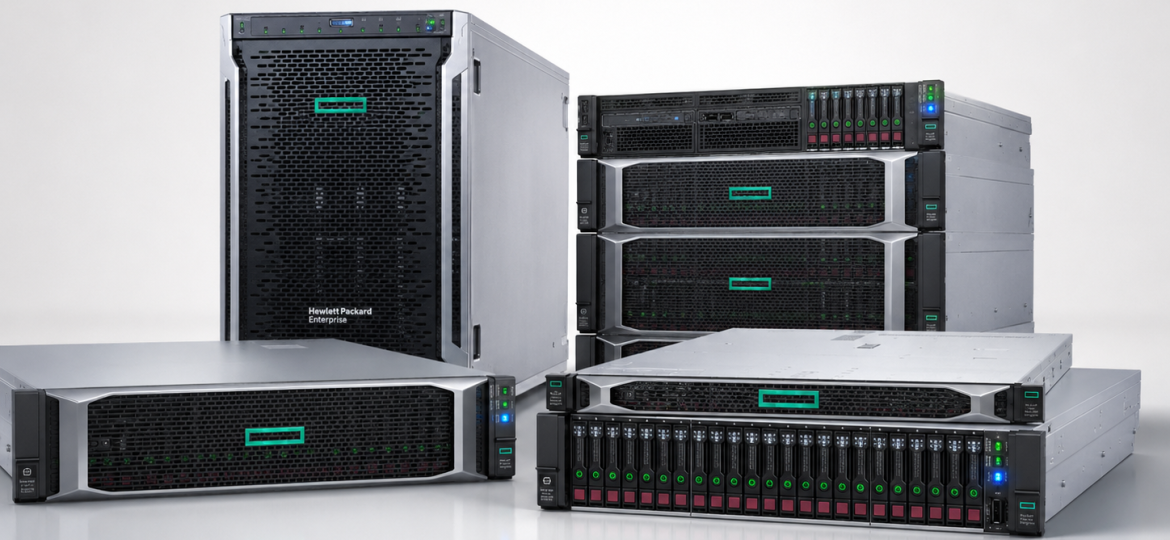
Before requesting a quote, it helps to be clear on what the server actually needs to do, because HPE’s ProLiant range is built around distinct use cases rather than a single “one size fits all” box:
Tower servers (ML series)
Suited to SMEs and branch offices that need a first dedicated server without a full data centre footprint. Compact, quieter, and easier to deploy outside a formal server room.
Key Models in the ML Series
- HPE ProLiant ML30: An entry-level, single-socket tower designed for small offices, supporting Intel Xeon E processors and up to PCIe Gen5 expansion in newer generations.
- HPE ProLiant ML110: A mid-range, single- or dual-socket tower utilising Intel Xeon Scalable processors that balances performance and expansion for growing workloads.
- HPE ProLiant ML350: A high-end, dual-socket powerhouse offering maximum expandability, extensive RAM capacity, and robust storage flexibility.
Rack servers (DL series)
The workhorse of most Nigerian enterprise and data centre deployments, built for density and designed to sit in a rack alongside other infrastructure. This is where most core application, database, and virtualisation workloads in Nigeria run today.
- DL20 Series (1U Entry): Compact, single-socket servers designed for small businesses, edge locations, and basic IT workloads.
- HPE ProLiant DL360 (1U Dense): A high-density, dual-socket 1U rack server optimised for virtualisation, web infrastructure, and dense environments.
- HPE ProLiant DL380 (2U Flagship): The industry standard 2U dual-socket workhorse that balances storage flexibility, expansion, and accelerator/GPU support for general enterprise use.
- DL325 / DL385 (AMD EPYC): AMD-powered single-socket (DL325) and dual-socket (DL385) variants built for high core-density and virtualisation efficiency.
- HPE ProLiant DL560 (4-Socket Enterprise): A robust 4-socket 2U/4U system built for heavy databases, mission-critical operations, and massive memory consolidation
High-density and specialised compute
For organisations running heavier virtual desktop infrastructure (VDI), AI, or high-performance workloads that need more cores, memory, and I/O than a standard rack server provides.
Getting this right at the start avoids the two most common and costly mistakes in Nigerian server procurement: under-buying a server that’s obsolete within eighteen months, or over-buying capacity that sits underused while tying up capital that could have gone into other infrastructure.
- HPE Cray Supercomputing GX5000: Features 6th Gen AMD EPYC processors, delivers high core density in a single rack, and uses direct liquid cooling for AI-driven science.
- HPE Compute Scale-up Server 3250: The 3250 server is engineered to unify disparate data sources and enable seamless integration across hybrid environments. Highly reliable, uniquely modular and secure server that scales from 4 to 16 6th generation Intel Xeon Scalable Processors, in 4-socket increments. Designed to support up to 64TB of shared memory.
Step 2: Confirm the model generation and configuration
HPE’s ProLiant Compute Gen11 and newer Gen12 servers are the current generation available through Nigerian distribution, spanning models like the ProLiant DL20, DL360, DL380, and ML30 in various processor, memory, and storage configurations. Each model is available with different processor tiers (from entry-level Xeon E-series chips to higher-core-count Xeon Scalable processors), memory capacity, and drive configurations (SFF or LFF, SATA, SAS, or SSD).
For most Nigerian SMEs, an entry- to mid-tier configuration a quad-core or 6-core processor, 16 – 32GB of RAM, and a modest SSD or HDD footprint, comfortably covers file serving, a departmental application, or a first virtualisation host.
Enterprise and institutional buyers running core banking applications, ERP systems, or larger virtualised environments typically need higher core-count Xeon Scalable configurations with redundant power supplies and larger memory footprints. This is where a pre-sales conversation with your distributor matters: the right configuration should be built around your actual workload, not a fixed catalogue price.
Step 3: Order through an HPE-authorised channel
This is the step where sourcing risk either gets eliminated or gets built into the deal. TD Africa is HPE’s authorised distribution partner in Nigeria, and was named HPE’s Distributor of the Year at the HPE Partner Awards, in recognition of its consistency, market execution, and standing as one of HPE’s most dependable partners in the region. That distribution relationship means every ProLiant server sourced through TD Africa is procured directly through HPE’s official supply chain, correctly configured for the Nigerian market, and eligible for full registration under HPE’s manufacturer warranty.
In practice, the ordering process looks like this:
- Needs assessment: share your workload, expected growth, and budget with TD Africa’s enterprise or data centre team so the configuration is matched to the job, not just the price point.
- Configuration and quotation: receive a formal quote against a specific part number and configuration, so what you’re paying for is unambiguous and traceable back to HPE.
- Order placement and lead time confirmation: larger or custom configurations may need to be sourced against HPE’s regional stock, so confirm lead times upfront, especially for time-sensitive rollouts.
- Delivery:TD Africa’s logistics network covers major commercial centres across Nigeria, including Lagos, Abuja, Port Harcourt, Kano, and other regional hubs, so delivery isn’t limited to buyers based in Lagos.
- Installation and warranty registration: confirm the unit is registered under HPE’s warranty at the point of delivery, not left as an afterthought. This is the step that protects you if something goes wrong six months in.
Step 4: Plan for support, not just the purchase
A server is a multi-year commitment, not a one-time transaction. Before the order is finalised, it’s worth confirming:
- Warranty terms and coverage period for the specific model and configuration ordered.
- Local support availability, whether break-fix support, spare parts, and technical escalation are available in-country, rather than requiring a shipment from outside Nigeria for a routine part replacement.
- Scalability path whether the model chosen has room to add memory, storage, or a second processor later, or whether growth will mean a full replacement sooner than expected.
- Data centre or hybrid cloud strategy for organisations exploring HPE’s GreenLake hybrid cloud model, it’s worth discussing early whether an on-premises purchase, a hybrid arrangement, or a consumption-based model fits the business better long-term.
Conclusion
Ordering an HPE server in Nigeria isn’t complicated once the workload is defined and the channel is right. The mistakes that actually cost businesses money happen earlier than the delivery date, in under-sizing the configuration, or in choosing a sourcing path that trades a short-term discount for a warranty that won’t hold up later. Define what the server needs to do, configure it against that need, and order through an authorised HPE distributor like TD Africa, and the rest of the process delivery, installation, and support, is built to work the way it’s supposed to.
Frequently Asked Questions (FAQs)
- Is TD Africa an authorised HPE distributor in Nigeria?
Yes. TD Africa is HPE’s authorised distribution partner in Nigeria and was named HPE Distributor of the Year, procuring HPE hardware directly through HPE’s official supply chain rather than through unofficial resale channels. - What’s the difference between an HPE tower server and a rack server?
Tower servers (the ML series) are standalone units suited to SMEs and branch locations without a dedicated server room. Rack servers (the DL series) are designed to be mounted in a server rack alongside other infrastructure and are the more common choice for enterprise data centres and growing IT environments in Nigeria. - How long does it take to receive an HPE server after ordering in Nigeria?
Lead times depend on whether the configuration is held in regional stock or needs to be sourced against a specific order. Confirming lead time at the quotation stage, before committing to a rollout date avoids project delays later.
