

Five years ago, cloud adoption was a competitive advantage. Today, it’s the baseline for doing business.
African enterprises face a choice: invest in ageing server rooms that drain capital and require constant maintenance, or shift to infrastructure that scales with demand and frees resources for growth. This guide covers what cloud adoption actually means, why the timing matters for African organisations, and how to build a strategy that balances ambition with practical realities.
What is cloud adoption?
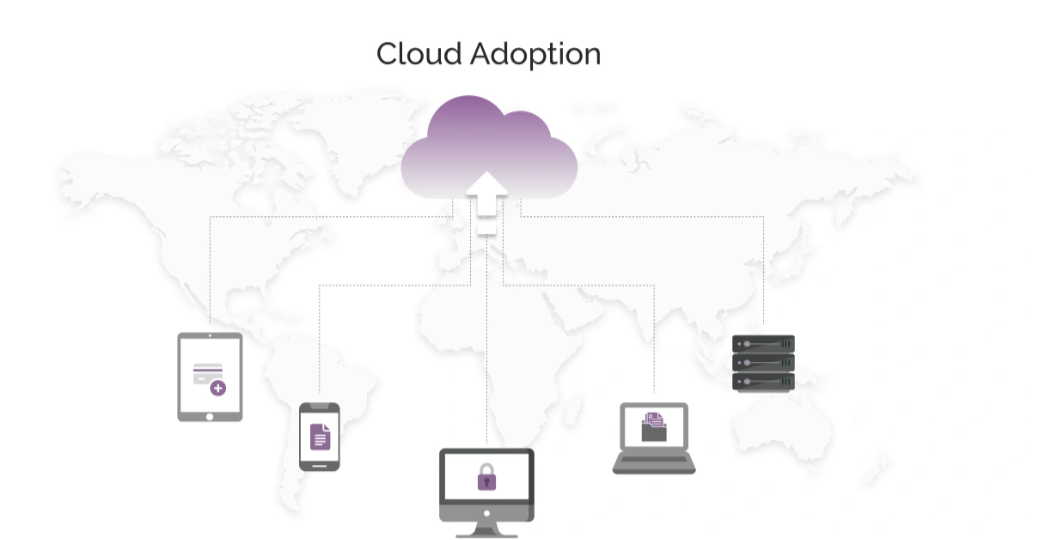
Cloud adoption is the process of moving your company’s IT infrastructure, data, and applications from on-premises servers to cloud-based platformsCloud adoption is the process of moving your company’s IT infrastructure, data, and applications from on-premises servers to cloud-based platforms. Instead of buying and maintaining physical servers in your office or data centre, you shift computing resources to remote infrastructure managed by providers like Microsoft Azure, IBM Cloud, or Nutanix Hybrid Cloud. Nutanix Hybrid Cloud.
Think of it like this: rather than owning a generator and fuel tanks, you plug into the national grid and pay for what you use. The cloud works the same way for computing power, storage, and software.
The process typically unfolds in phases. First comes planning and strategy, where you figure out what to move and why. Then comes the actual migration, followed by ongoing governance and optimisation. Most organisations guided by frameworks from AWS or Microsoft follow a structured path: define business goals, prepare the environment, migrate workloads, then manage and improve over time.
For African businesses, cloud adoption solves a real problem. Building and maintaining data centres is expensive, and finding skilled IT staff to manage them is even harder. Cloud platforms let you access world-class infrastructure without the capital outlay.
Why African businesses can no longer delay cloud migration
The competitive landscape across Africa has changed. Customers expect digital-first experiences. Partners want real-time collaboration. Markets reward speed over size.
Picture a Lagos-based logistics company bidding for regional contracts. Without cloud infrastructure, they’re tracking shipments on spreadsheets while competitors offer real-time dashboards. Or consider a Nairobi fintech trying to scale; every new customer means more server capacity, more IT staff, more capital locked up in hardware that depreciates the moment you buy it.
Here’s what’s pushing the urgency:
Global competition: International players entering African markets already run on cloud infrastructure, giving them cost and speed advantages from day one.
Customer expectations: Both B2B and B2C customers now expect 24/7 digital access, mobile-first interfaces, and instant responses.
Talent mobility: Skilled workers want modern tools. Legacy systems make it harder to attract and keep top talent.
Regulatory evolution: Data protection laws across Africa are maturing, and cloud providers often offer compliance frameworks that simplify adherence.
The question isn’t whether to adopt the cloud. It’s how quickly you can make the transition without disrupting what’s already working.
Key benefits of cloud adoption for enterprises
Reduced IT costs and capital efficiency
Traditional IT demands big upfront investments: servers, cooling systems, physical security, backup power, and dedicated staff to keep everything running. Cloud computing flips this model. Instead of capital expenditure, you pay operational expenses based on actual usage.
For many African enterprises, this shift frees up capital for core business activities. A mid-sized manufacturer, for example, might redirect funds previously earmarked for server upgrades toward production equipment or market expansion. The money stays in the business rather than sitting in a server room.
Scalability that matches business growth
Cloud infrastructure grows and shrinks with demand. During peak seasons, you increase capacity. During slower periods, you scale back. You pay only for what you use.
Imagine a retail business preparing for Black Friday sales. With on-premises infrastructure, they’d provision for peak demand year-round—paying for servers that sit idle most of the time. With the cloud, they scale up for the event and scale down afterward. The flexibility is built into the model.
Improved security and compliance
Here’s something that surprises many business leaders: cloud platforms often provide stronger security than most organisations can achieve on their own. Major providers invest billions in security infrastructure, employ dedicated security teams around the clock, and maintain certifications that would be prohibitively expensive for individual businesses to obtain.
- Security Feature
- On-Premises
- Cloud Platform
- 24/7 monitoring
- Requires dedicated staff
- Included
- Automatic patching
- Manual process
- Automated
- Disaster recovery
- Expensive to implement
- Built-in options
- Compliance certifications
- Self-managed
- Provider-maintained
- Business agility and faster innovation
Cloud adoption accelerates how quickly you can test new ideas, launch products, and respond to market changes. Development teams can spin up test environments in minutes rather than waiting weeks for hardware procurement and setup.
This agility compounds over time. Organisations that adopt cloud early build institutional knowledge and processes that make subsequent innovations faster and less risky. They learn what works, refine their approach, and move faster with each iteration.
Common cloud adoption challenges and how to overcome them
Technical complexity during migration
Moving existing applications and data to the cloud isn’t always straightforward. Legacy systems may require refactoring, essentially rewriting parts of the code to work in a cloud environment. Some applications might not be cloud-ready without significant modification.
The practical solution is phased migration. Start with less critical workloads to build expertise, then tackle more complex systems once your team has confidence. Working with experienced partners who understand both global cloud platforms and local infrastructure realities can significantly reduce risk and shorten timelines. Experienced partners who understand both global cloud platforms and local infrastructure realities can significantly reduce risk and shorten timelines.
Security and compliance concerns
Many organisations hesitate because they’re uncertain about data sovereignty and regulatory compliance. Where will data be stored? Who can access it? How do local regulations apply to cloud-hosted information?
These concerns are valid, and they’re addressable. Hybrid cloud environments combining public cloud services with private infrastructure offer flexibility for sensitive workloads. You can keep certain data on-premises while running less sensitive applications in the public cloud. Partners working with providers like Checkpoint Cloud Guard and Cisco Meraki specifically address security requirements for African enterprises operating under local data protection laws.
Managing costs during transition
Cloud adoption can actually increase costs if not managed carefully. Without proper governance, teams may provision more resources than they actually use, or leave unused services running indefinitely. The pay-as-you-go model works both ways.
Effective cloud governance includes a few key practices:
1. Clear ownership: Assign responsibility for cloud spending to specific teams or individuals who track and justify usage.
2. Usage monitoring: Implement tools that track consumption and alert on anomalies before bills spiral.
3. Right-sizing: Regularly review whether provisioned resources match actual workload requirements.
4. Reserved capacity: For predictable workloads, reserved instances often cost significantly less than on-demand pricing.
Skills gaps and change management
Cloud technologies require different skills from traditional IT. Your team may need training on new platforms, and organisational processes may need updating to take advantage of cloud capabilities.
Tip: Start your cloud journey with a pilot project that has clear success metrics. A single application or workload gives your team hands-on experience and provides learning opportunities before larger migrations.
This is where strategic partnerships prove valuable. Rather than building all expertise internally, which takes time and money, organisations can leverage partners who provide training, ongoing support, and access to certified professionals.
How to build a cloud adoption strategy
Assess your current infrastructure
Before migrating anything, understand what you have. Document existing applications, data flows, dependencies, and performance requirements. Identify which workloads are cloud-ready and which will require modification.
This assessment also reveals quick-win applications that can move to the cloud with minimal effort and deliver immediate benefits. Starting with quick wins builds momentum and demonstrates value to stakeholders who may be sceptical.
Define business objectives and success metrics
Cloud adoption isn’t a technology project. It’s a business transformation. Define what success looks like in business terms: reduced time-to-market, lower operational costs, improved customer satisfaction, or enhanced collaboration across locations.
These objectives guide decisions throughout the migration process. When you face trade-offs, and you will clear business goals can help you choose the right path. They also help justify continued investment to leadership and boards.
Choose the right cloud model
Not every workload belongs in the same environment. Public cloud offers maximum scalability and minimal management overhead. Private cloud provides greater control for sensitive workloads. Hybrid approaches combine both based on specific requirements.
For many African enterprises, hybrid cloud environments offer the best balance of flexibility, control, and cost efficiency. TD Africa works with providers including Nutanix, Dell, IBM Cloud, and Microsoft Azure to deliver hybrid solutions tailored for organisations navigating local infrastructure realities alongside global platform capabilities. Dell, IBM Cloud, and Microsoft Azure to deliver hybrid solutions tailored for organisations navigating local infrastructure realities alongside global platform capabilities.
Plan for governance and optimisation
Cloud adoption isn’t a one-time event. Establish processes for ongoing management, cost optimisation, and security monitoring. Define policies for provisioning new resources, managing access, and responding to incidents.
Organisations that treat cloud as a continuous journey rather than a destination consistently achieve better outcomes. The technology evolves, your business evolves, and your cloud strategy evolves alongside both.
Getting started with cloud adoption
The path forward is clearer than it might seem. African businesses across sectors, from financial services to manufacturing to healthcare, are already realising the benefits of cloud infrastructure. The early movers are building competitive advantages that will compound over time.
The first step is understanding your specific situation: current infrastructure, business objectives, and constraints. From there, you can develop a roadmap that balances speed with risk management.
TD Africa partners with leading cloud providers including Nutanix Hybrid Cloud, including Nutanix Hybrid Cloud, Dell, Checkpoint, Cisco Meraki, IBM Cloud, and Microsoft Azure, to deliver cloud solutions designed for African enterprises. Whether you’re exploring cloud for the first time or optimising an existing deployment, expert guidance makes the journey smoother.
Ready to explore what cloud adoption could mean for your organisation? Connect with TD Africa’s cloud solutions team to start the conversation.
Frequently asked questions
What is the difference between cloud migration and cloud adoption?
Cloud migration refers specifically to moving existing applications and data to cloud infrastructure. Cloud adoption is the broader strategic process that includes migration but also encompasses new cloud-native development, organisational change, and ongoing optimisation. Migration is a task; adoption is a transformation.
How long does cloud adoption typically take?
Timelines vary significantly based on organisational size, complexity, and objectives. Initial pilot projects might take weeks, while enterprise-wide transformations often span months or years. Phased approaches allow organisations to realise benefits incrementally rather than waiting for complete migration before seeing results.
Can cloud adoption work for businesses with unreliable internet connectivity?
Yes, though it requires thoughtful architecture. Hybrid cloud models allow critical workloads to run locally while leveraging the cloud for less latency-sensitive applications. Edge computing solutions and offline-capable applications can also address connectivity challenges common in some African markets. The key is designing for the reality of your infrastructure, not an ideal scenario.
