

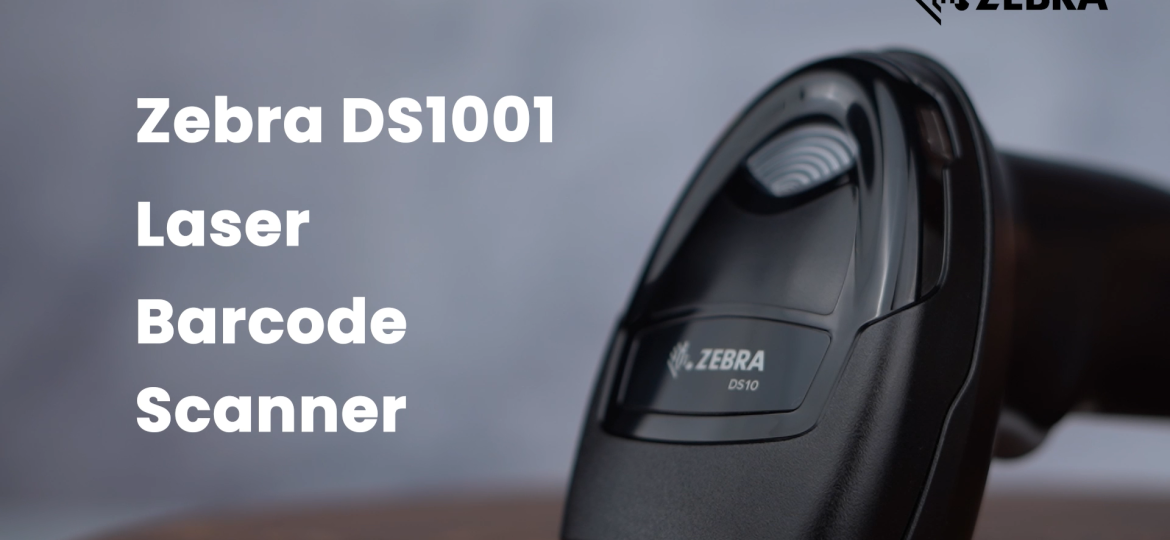
If your clients are operating high-throughput counter environments, from retail POS counters, a hospitality front desk, a pharmacy, or any environment where speed and accuracy matter, the Zebra DS1000 Series (often referenced as DS1001, including DS1001-SR00004ZZ-B) is designed to deliver dependable barcode scanning without the cost and complexity of higher-end enterprise models.
It gives you reliable 1D/2D performance without forcing your customers into an enterprise-level spend, making it a high-value, easy-to-pitch upgrade for budget-conscious businesses.
As a corded, handheld 1D/2D imager, it combines high-speed performance, straightforward plug-and-play deployment, and durability for continuous daily use. For businesses that need reliable scanning on a practical budget, it offers the right balance of efficiency, simplicity, and value.
What the Zebra DS1000 Series Is Built For
1) Fast, dependable scanning at the point of service
The Zebra DS1000 Series is designed to minimise misreads and repeated scans, enabling cashiers and frontline staff to work with greater speed and confidence. The result is smoother customer flow, shorter queues, and a more efficient service experience, especially during peak hours.
2) 1D and 2D barcode support (future-ready)
Many businesses still rely on 1D barcodes, but 2D codes (like QR codes) are rapidly becoming standard for digital receipts, loyalty programs, and mobile payments. Investing in a scanner that reads both formats ensures you’re ready for that shift without needing to replace hardware later. It’s a simple way to future-proof your checkout environment while maintaining operational continuity.
3) Corded convenience for always-on operation
The DS1000 Series is engineered for fixed-location workstations that demand maximum uptime and zero maintenance overhead.
- Zero-Battery Logistics: By drawing power directly from the host terminal via USB, the DS1000 Series remains live for the entire duration of the workstation’s shift, typically 8–12 hours. This eliminates the need for charging schedules, the cost of maintaining spare battery pools, and the operational risk of a device dying mid-transaction. For fixed points like retail POS, pharmacy counters, and hospital admissions, a corded connection ensures the scanner is always powered and always exactly where the staff left it.
- Solid Signal Integrity and Instant Deployment: The direct USB connection provides a consistent, high-speed data link that is immune to Bluetooth pairing drops or 2.4GHz signal interference common in crowded wireless environments. For IT administrators and resellers, this means a “plug-and-scan” experience: the operating system recognises the device instantly without driver installations or specialist setup. Troubleshooting is simplified to a physical cable check, ensuring a reliable connection from the first scan of the day to the last.
Why Getting the Right Scanner Is Only Half the Job
A lot of businesses buy devices, but later struggle with:
- Availability and lead times: Barcode scanners are functional equipment rather than optional purchases. When a unit fails or a new counter needs to be equipped, the business needs a replacement quickly, not in six to eight weeks.
In the Nigerian market, some vendors list products they do not physically hold in stock, creating avoidable delays after payment and leaving buyers in a holding pattern that disrupts operations.
Working with a distributor like TD Africa that holds physical stock in-country means that when you need units, they are available, not promised. For businesses deploying across multiple locations or scaling up quickly, this distinction between guaranteed availability and optimistic lead times can be the difference between a smooth rollout and a delayed one.
- Genuine products vs Unauthorised Supply Channels: At the point of sale, devices sourced through unofficial channels often look identical to genuine units. The packaging appears intact, and the hardware powers on. On the surface, there’s no obvious difference. The distinction becomes clear later, as some devices arrive with international firmware not configured for local operating conditions. Others may have been repaired or refurbished before being repackaged and sold as new.
In many cases, there is no valid manufacturer warranty tied to the serial number. Beyond the hardware itself, products sourced outside authorised distribution are typically not covered by the manufacturer’s warranty. Any defects, failures, or compatibility issues become the reseller’s or end user’s financial responsibility.
When purchased through an approved distributor such as TD Africa, genuine Zebra Technologies equipment comes properly region-configured, backed by a legitimate manufacturer warranty, and supported by a traceable, accountable supply chain.
The difference is not visible on day one; it becomes visible when support is needed.
- The Right Model Selection (SR vs other variants, cable types, etc.): The DS1000 Series has several variations, and a reseller unfamiliar with the product line may not always be able to tell the difference between them. The performance of the scanner at various distances from the barcode is determined by SR (Standard Range) versus extended range configurations. This is important if your application requires scanning things on a shelf rather than passing them straight over a counter.
Cable type matters too; USB Type-A, USB Type-C, and RS-232 serial connections are not interchangeable, and ordering the wrong cable type for an existing POS setup means the hardware cannot be deployed until the right cable arrives.
These are the kinds of specification details that an informed reseller resolves before the order is placed, not the kind of detail a customer should discover after delivery.
- Support, Warranty guidance, and Deployment Help: The majority of distributors in this market sell the box and declare the deal final. The transaction is only the first step for a company that installs scanners throughout a network of schools, a hospital, or a chain of stores. What occurs if, six months after deployment, a unit develops a defect? Who handles the manufacturer’s warranty claim procedure? Who advises on whether the equipment requires a configuration adjustment, repair, or replacement?
Authorised distributors respond to these enquiries as part of the partnership, not as an afterthought. Businesses purchasing Zebra hardware through the TD Africa channel have a point of contact for technical questions, warranty escalations, and deployment help that continues after the initial purchase, due to the post-purchase infrastructure of TD Africa.
Common Use Cases
- Retail POS: Scan speed and read reliability make all the difference between a seamless customer experience and a growing queue at a busy checkout counter. The DS1000 Series can read both 1D barcodes and 2D QR codes in a single pass, so the cashier doesn’t need to switch devices or change settings to handle everything from product shelf labels and price tags to digital receipts, mobile payment codes, and loyalty program scans.
The plug-and-scan USB connection allows multi-branch shops to standardise equipment across locations, ensuring that each device installs identically with no configuration changes, no compatibility difficulties with existing POS software, and no need for specialised IT at each site. - Hospitality: In hotel front desks, quick-service restaurants, and lounges depend on smooth, frictionless workflows. The Zebra DS1000 Series supports everyday operational tasks, from scanning booking confirmation QR codes at check-in to reading supplier barcodes, loyalty cards, and access credentials. For quick-service restaurants handling both digital and printed order tickets, its 2D imaging capability ensures accurate reads without slowing service. The corded design adds another advantage: always docked, always powered, and always within reach, reducing friction during peak periods when every second at the counter matters.
- Pharmacies & clinics: In a pharmacy or clinic setting, scanning errors are not just operational problems; they have safety implications. The DS1000 Series reads the small, curved, and sometimes poorly printed barcodes commonly found on medicine bottles, packaging strips, and patient documentation accurately on the first attempt, reducing the need for manual re-entry that introduces error risk.
For inventory workflows, it integrates directly with the pharmacy management system via USB, enabling staff to scan incoming stock, verify expiry dates against records, and update dispensing logs without switching between manual and digital processes. For clinics managing patient registration or specimen tracking at an admissions desk, it brings the same speed and read reliability to a counter that cannot afford delays. - Warehousing (light duty): At a receiving desk or stockroom counter, the DS1000 Series handles the core data capture tasks that keep inventory records accurate, scanning inbound delivery barcodes, verifying purchase orders against physical stock, and logging goods into inventory management systems.
Its omnidirectional scanning capability means staff do not need to carefully align each item to the scanner; products can be passed across the field at a natural angle, and the scanner decodes consistently, which matters when a delivery of several dozen SKUs needs to be processed quickly. For light-duty warehouse environments where a fixed counter scanner is sufficient, and the budget does not justify a ruggedised mobile computer, the DS1000 Series delivers the right level of capability without over-specifying the solution.
- Education & libraries: For schools, colleges, and libraries, staff need a scanning system that is simple to use, resilient enough for daily handling, and reliable enough to keep circulation and inventory workflows running smoothly. The DS1000 Series meets all of these requirements. It performs consistently in shared-use environments, reading the barcodes most library management and asset tracking systems rely on, right out of the box. For institutions with limited budgets, its corded USB design eliminates the recurring cost and logistical overhead of managing batteries across multiple departments or branches, making life easier for the people who rely on it every day.
If you’re supplying devices to end customers, a TD Africa partnership can be the difference between “one-off sales” and a repeatable, scalable pipeline.
FAQ
1) What is the Zebra DS1000 Series?
The Zebra DS1000 Series is an entry-level corded handheld barcode imager that supports both 1D and 2D barcodes, designed for fast, reliable scanning in retail, hospitality, and general-purpose environments.
2) Is DS1001 the same as DS1000 Series?
“DS1000 Series” refers to the product family, while DS1001 is a commonly referenced model within that family. The specific unit you mentioned, DS1001-SR00004ZZ-B, is a particular configuration/SKU.
3) Does the DS1000 Series scan QR codes?
Yes. Since it is a 2D imager, it can scan 2D codes such as QR codes (commonly used for loyalty, promotions, tickets, mobile payments, and digital menus), in addition to traditional 1D barcodes.
4) What’s the difference between a 1D laser scanner and a 2D imager like the DS1000?
A 2D imager can read:
- 1D barcodes (traditional)
- 2D barcodes (QR/Data Matrix, etc.)
So you get broader compatibility and more future readiness than many basic 1D-only scanners.
5) Is it durable enough for retail counters?
It’s marketed as durable for everyday business use, built to handle routine handling in busy environments (retail, hospitality, service desks).
6) Can the DS1000 Series support high-volume scanning?
It’s designed for high-speed, reliable scanning, making it suitable for busy counters and repeated scanning workflows.
7) What does it mean to become a partner with TD Africa?
It means your business gains access to TD Africa’s distribution and enablement structure, helping you source products more consistently and serve your customers better, especially if you are a reseller, system integrator, or enterprise procurement team.
Conclusion
The Zebra DS1000 Series offers fast, reliable 1D/2D scanning with simple, plug-and-play deployment, making it a smart, cost-effective fit for busy counter environments.
Backed by TD Africa, you also gain guaranteed authenticity, correct configuration, local availability, and ongoing support. Together, they provide not just a scanner, but a dependable, scalable solution for growing businesses and resellers.
