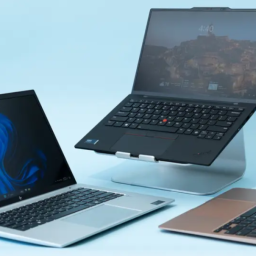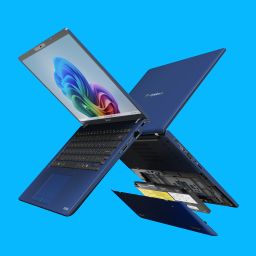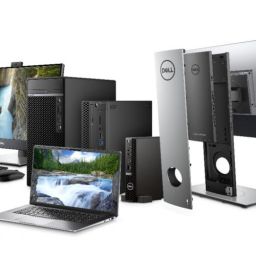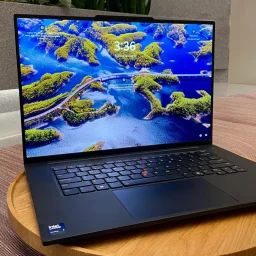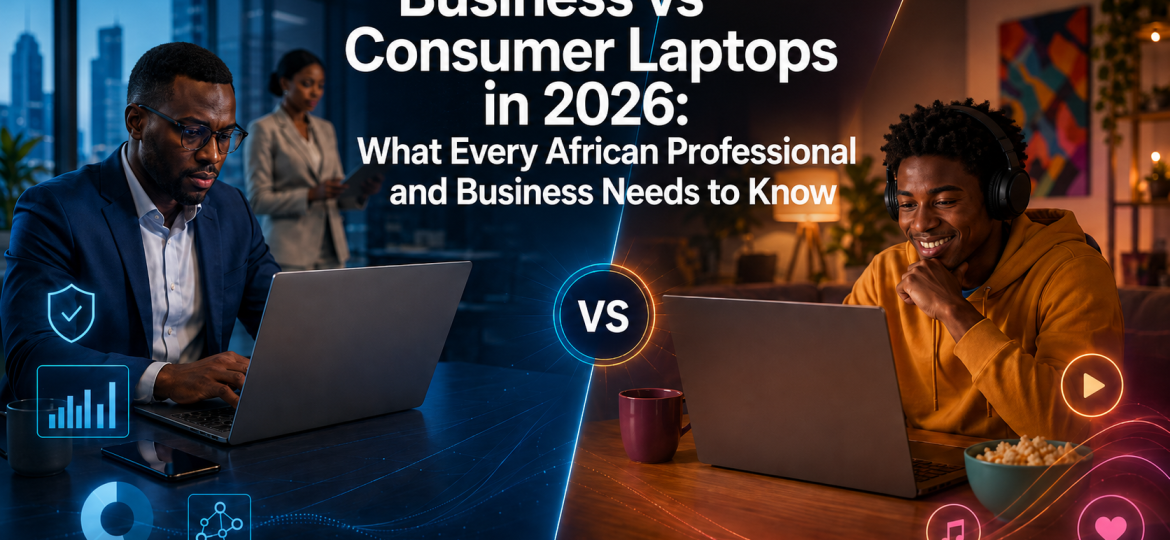
In 2026, artificial intelligence is being baked directly into laptop hardware, hybrid work is now a permanent work mode across African businesses, and the question buyers face is no longer just about the brand, but the efficiency of the device purchased.
While consumer computers tend to focus more on design, entertainment, or price-led value, business computers typically prioritise security, manageability, dependability, longer support cycles, and build quality.
The Global Laptop Market in 2026
The global business laptop market is valued at approximately USD 29.7 billion in 2026, and is expected to reach nearly USD 45.6 billion by 2035, advancing at a compound annual growth rate of 6.3%. That growth is being driven by enterprise mobility, hybrid work adoption, and the rapid integration of AI into business computing.
In Africa, educational programmes, government digitisation initiatives, and business procurement are key demand drivers, and notably, 61% of laptop buyers in the region still prefer physical retail, citing the ability to test specifications, keyboard feel, and screen quality before purchase..
What Is a Business Laptop?
A business laptop is designed for reliability, durability, and long-term use. It often includes stronger security features, longer battery life, and the ability to handle heavy workloads. Consumer laptops are usually more affordable and may feature flashier designs, but they may not perform as well under constant, demanding use.
Business laptops prioritise features your organisation actually depends on, more ports, better keyboards, superior webcams for video calls, and the management tools your IT team needs to keep devices secure and productive across your entire fleet.
In 2026, business laptops also carry something new: dedicated AI accelerators (Neural Processing Units or NPUs) integrated with enterprise-grade platforms like Intel vPro and AMD PRO, enabling on-device AI tools to run securely without cloud dependency.
Business Laptop vs Consumer Laptop
| Feature | Business Laptop | Consumer Laptop |
| Security | TPM chips, fingerprint readers, BitLocker, enterprise MDM | Basic antivirus, Windows Home edition |
| Build Quality | Metal/carbon fibre chassis, MIL-SPEC tested | Mostly plastic, optimised for aesthetics |
| Battery Life | 12–18+ hours; often user-replaceable | 6–10 hours; typically glued-in cells |
| Repairability | Modular RAM, SSD, keyboard | Soldered components; expensive to repair |
| Ports | HDMI, Ethernet, multiple USB-A/C, SD card | Fewer ports; relies on dongles |
| AI Features | Enterprise NPU; Intel vPro/AMD PRO | Consumer NPU: optimised for personal use |
| OS | Windows 11 Pro, domain-join ready | Windows 11 Home; limited IT management |
The Six Differences That Matter Most
1. Build Quality and Durability
Business machines from Lenovo, Dell, and HP use metal chassis, carbon fibre reinforcement, and magnesium alloy frames. Consumer models rely majorly on plastic. This matters because plastic flexes under stress, which puts pressure on internal components and solder joints over time. Metal and carbon fibre keep everything rigid, protecting the motherboard and connections that actually determine how long a laptop runs.
If your team travels between offices or works in warehouses, clinics, or field environments, this structural difference directly affects how long the device serves them.
2. Security – A Non-Negotiable in the African Context
Security has moved from just an IT concern to a company’s overall issue. An Interpol report reveals a continent-wide escalation of cybercrime, with about one in 15 organisations in Africa facing a ransomware attempt each week, significantly higher than the global average. For many SMEs, a breach represents an existential threat.
Business-grade laptops come standard with secure features like TPM (Trusted Platform Module) chips, fingerprint readers, and Windows Pro with BitLocker encryption. Business-grade devices are also designed to support enterprise IT tools like remote management, group policy, and cybersecurity platforms.
Consumer laptops ship with Windows 11 Home, which lacks these enterprise capabilities and is not suitable for professional IT environments managing sensitive data.
3. Battery Life and Power Resilience
In the African markets, power reliability is a genuine operational variable. Frequent power outages mean battery performance is not a convenience feature; it is a productivity requirement.
Business laptops are designed and optimised for travelling and longer active periods than personal-use laptops, resulting in better efficiency in battery life, speed, and power to keep up with a 40-hour workweek. Battery life, speed, and power are even more critical when supporting video conferencing demands as organisations adopt remote and hybrid work.
4. Repairability and Long-Term Value
Business laptops are designed so IT teams can swap out RAM, storage drives, batteries, and even keyboards without specialised tools. Consumer laptops increasingly solder components directly to the motherboard, making upgrades impossible and repairs expensive. When a business laptop’s SSD starts to slow down after two years, you can replace it and get another full year of life.
A well-maintained business laptop delivers 4 to 6 years of productive use, while a consumer laptop of similar price starts struggling at 2 to 3 years. Over 6 years, you will likely purchase one business laptop or two to three consumer ones, making the business model the better long-term ROI.
For African SMEs managing capital carefully, this total cost of ownership (TCO) calculation often makes the more expensive business laptop the smarter financial decision.
5. AI Integration in 2026
According to Gartner, Artificial intelligence (AI) PCs will represent 31% of the total PC market globally by the end of 2025, according to Gartner, Inc. a business and technology insights company. Worldwide shipments of AI PCs are projected to total 77.8 million units in 2025.
The most important AI trend for African businesses is not experimentation with standalone tools, but the quiet embedding of AI into everyday business workflows. Finance, HR, supply chain, and customer operations are increasingly augmented by AI that automates routine tasks, highlights risks, and supports better decisions. A business laptop with a dedicated NPU handles these workloads efficiently and securely on-device without the need to send sensitive data to the cloud.
Consumer laptops also carry NPUs in 2026, but they are tuned for personal productivity tools, entertainment, and creative applications, not enterprise security or fleet-managed AI deployments.
How Should You Advise Your Customers?
- Growing SMEs: Businesses that depend on technology to function, not just to browse the internet; the device carrying your operations needs to match that responsibility. A growing SME cannot afford the disruption of a laptop failure mid-quarter, a security breach that compromises client trust, or a device that slows down under the weight of multiple applications running simultaneously. Business laptops are engineered for exactly the workload that comes with running a real operation. As your team grows, the hardware needs to grow likewise, and business-grade devices are built with that scalability in mind.
- Team handling sensitive data (financial or health data): If your business handles personally identifiable information, financial records, medical files, legal documents, or anything that requires clients to entrust their data, a consumer laptop is not the right tool. Business laptops come with hardware-level security features, TPM chips, BitLocker encryption, fingerprint readers, and Windows 11 Pro, specifically designed to prevent unauthorised access even if the device is lost or stolen. In a regulatory environment where data protection obligations are tightening across Africa, the right hardware is part of your compliance posture.
- Staff working remotely or traveling regularly: Remote and hybrid work is now the default for many African businesses, and devices need to match that reality. Business laptops are MIL-SPEC tested for durability in transit, drops, vibrations, humidity, and temperature changes that are common when your customers are moving between Abuja, Accra, Johannesburg, or Nairobi. They also offer longer battery life, better webcam and microphone quality for video calls, and built-in connectivity options like 4G/5G that keep teams productive regardless of where they are working from.
- Your IT team needs to manage devices centrally: Once your organisation has scaled to a certain size, managing laptops device-by-device becomes unsustainable. Business laptops support enterprise tools like Microsoft Intune, Intel vPro, and Active Directory, platforms that allow your IT team to push updates, enforce security policies, remotely wipe a lost device, and monitor device health across your entire fleet from a single dashboard. Consumer laptops running Windows 11 Home do not support these capabilities. If your customer’s IT infrastructure depends on centralised management, their devices need to be built for it.
For Consumer Laptops
- Student, individual creator, or freelancer: For primary use cases such as coursework, content creation, design, writing, or managing your own independent projects, a consumer laptop gives you strong performance and great design at a price point that makes sense for your budget. They do not need enterprise security management, centralised IT control, or MIL-SPEC durability; they need a capable, portable device that handles daily workflow and keeps up with the creative or academic demands of work.
- Tight budget with moderate usage: If you want to use your laptop for a few hours each day for emails, video calls, documents, light browsing, and streaming, a mid-range consumer laptop will handle everything required without stretching your budget unnecessarily.
- A gaming or high-performance multimedia machine: Consumer laptops, particularly gaming laptops, are built to prioritise graphics performance in a way that business laptops deliberately are not. If your priority is a high refresh-rate display, a dedicated GPU for gaming, video rendering, or 3D modelling, and immersive audio, the consumer category is where to find the hardware built for those demands. Business laptops trade GPU performance for battery efficiency and manageability, a reasonable trade-off for enterprise work, but the wrong one for gaming or heavy creative rendering.
Top Models to Watch in 2026
Business Laptops
- Lenovo ThinkPad X1 Carbon Gen 13: The gold standard for business mobility. Intel Panther Lake processor, up to 18-hour battery, MIL-SPEC 810H certified, and optional 5G connectivity.
- HP EliteBook 8 G2: HP’s 2026 flagship business laptop, available with AMD Gorgon Point and Intel Panther Lake configurations. Enterprise AI features, strong durability, and a best-in-class keyboard.
- Dell Latitude 7450: Thin, light, premium display, and the full Dell enterprise security and management stack. Ideal for executives and frequent travellers.
- HP ProBook 4 G2: HP’s accessible entry into its 2026 business lineup. Balances cost with core enterprise features, a strong choice for growing SMEs equipping their first fleet.
Consumer Laptops
- Apple MacBook Air M4: Exceptional performance-per-watt, premium aluminium build, and an average lifespan of 7–10 years. The best consumer laptop for professionals outside a corporate Windows environment.
- Samsung Galaxy Book4 Ultra: Windows-based premium consumer option with OLED display and creator-focused hardware. Strong for media professionals.
- ASUS Zenbook 14 OLED: Excellent all-rounder with AI features, thin-and-light design, and competitive pricing relevant to the African market.
- Acer Aspire 5 (2026 Refresh): The most capable budget consumer laptop for students and cost-conscious buyers in emerging markets.
Conclusion
In 2026, the distinction between business and consumer laptops is real, measurable, and, particularly for organisations operating across Africa, consequential.
Consumer laptops are not poor products; they are simply not engineered for the demands of a professional workweek, enterprise security environments, or the infrastructure realities many African businesses navigate daily. For businesses of any size, from a Lagos fintech startup to a Nairobi logistics firm to a Johannesburg law practice, investing in business-grade hardware is investing in uptime, security, and long-term productivity.
For individuals, students, and creatives, consumer laptops remain compelling, capable, and increasingly affordable.
The right laptop is not the one on the shelf; it is the one that fits your customers’ and organisation’s workload, their environment, and the organisation’s growth trajectory. Understanding this separates you from just another technology seller.
At TD Africa, we work with businesses every day across Sub-Saharan Africa, from fast-growing SMEs to established enterprises, helping them make exactly this decision. As one of the continent’s leading technology distributors, we work directly with the world’s foremost laptop brands, which means we see firsthand what happens when organisations choose the right hardware and what it costs when they do not.
Visit tdafrica.com/partner or reach out to our team at enquiries@tdafrica.com.
FAQ
1.I run a small business with a tight budget. Can I not just use a consumer laptop to save costs?
You can, but it is worth doing the full math before you decide. A consumer laptop may cost less upfront, but factor in a shorter lifespan of 2–3 years under professional use, limited repairability when something fails, a basic one-year warranty with no on-site support, and a higher vulnerability to the cybersecurity threats that are increasingly targeting African SMEs.
2. My team is small; do I really need a business laptop, or is that only for large corporations?
Business laptops are not reserved for large enterprises; they are arguably more important for small and growing teams. A large corporation has dedicated IT departments, redundant systems, and the resources to absorb device failures and security incidents.
3. What is the most important difference between a business and consumer laptop for businesses operating in Africa specifically?
Battery life and security stand out as the two most Africa-specific factors. Power reliability remains an operational variable across many African markets; frequent outages mean a laptop that delivers 12–18 hours of battery life is essential infrastructure for your team’s productivity.